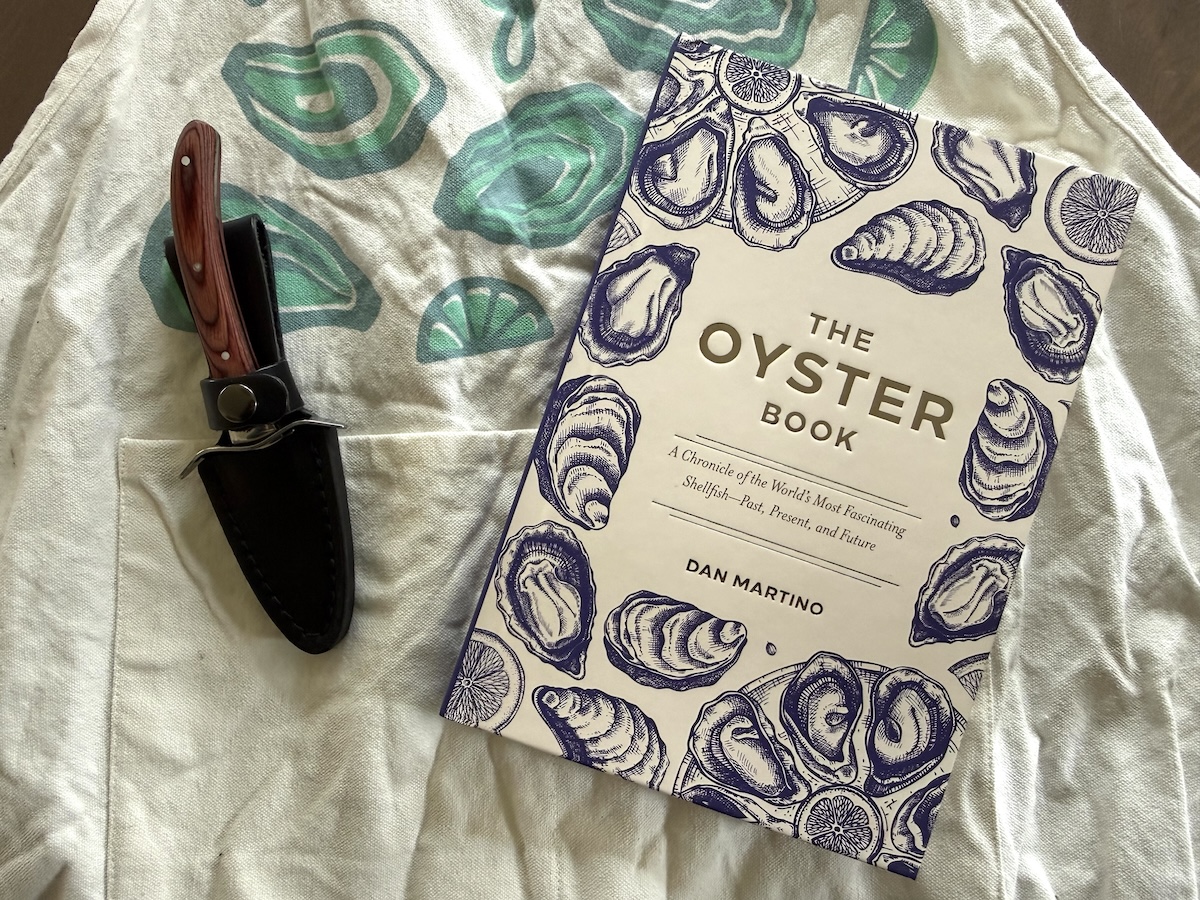
Thousands of visitors each year, writes Dan Martino, sign on for one-hour BYOB voyages aboard his Cottage City Oysters farm tour vessel. Each tour involves “a lively, multifaceted conversation about oysters, the culture, and the future of humanity, all while drinking our favorite beverages, eating an endless supply of freshly harvested oysters, and cruising around in one of the most beautiful and pristine ocean environments the world has to offer.”
Those conversations informed Martino’s The Oyster Book, and upon being informed of this on page four, it’s hard not to spend each of the remaining three hundred six pages wishing you were out there on the boat instead of sitting somewhere else reading the longer, less flavorful version of the author’s oyster schtick.
Despite its authoritative title, The Oyster Book leaves a lot of relevant material unharvested. You’ll read nothing about how to purchase or prepare oysters, except for mouth-watering references to the numerous oyster bars located near many of the world’s prime bivalve habitats. Much of the oyster’s cultural history is passed over, in favor of a vast span of natural history. (“Roughly 4.54 billion years ago the Earth was formed…”)
Really, Martino has penned a manifesto for the merits of his own line of work. Readers are constantly being reminded that oyster farming is the most sustainable form of protein generation, and that if the creatures were to be unleashed to their maximum reproductive potential, oyster shells could sequester enough carbon to neutralize the emissions of, say, India.
Nor is the author overly modest about the merits of his own oysters, farmed off Martha’s Vineyard. “Most oyster farmers have not even heard of merroir yet!” wrotes Martino, indulging his propensity for exclamation. “The term is used by the best of us, those farmers in search of ways to make their product better, and who wish to understand the environments we grow in.”
Thus it is that we learn what even a successful oyster farmer envies: the acclamation of the successful vintner, whose terroir is appreciated (at least in theory) by even the ordinary guzzler. “Merroir” is the aquatic equivalent: the effect of a specific growth environment on the taste of the harvested oyster.
The Oyster Book did show me, despite the large number of oysters I have eaten, how little I comprehended of their lives and times. Prior to reading Martino’s book I could not have told you how oysters reproduce; now, I invite you to ask me how oyster spat are conceived and where they prefer to settle. I also had no idea how vanishingly rare wild oyster reefs have become; the vast majority of oysters eaten today are farmed, and most are of a single hardy Japanese variety now growing off shores around the world.
Whereas oysters are now considered a delicacy, in the distant past they were a staple protein source for communities around the world. Overharvesting was the death knell for once-plentiful oyster reefs, and now the revival of such reefs is a utopian project.
Sitting in Minnesota reading The Oyster Book, I noticed that Martino makes little mention of the environmental impact of the infrastructure required to transport fresh oysters from farm to table when said table is not in a farm’s immediate vicinity. That said, significantly expanding bivalves’ share of the world’s protein consumption would certainly involve expanded processing: oysters raw on the half-shell aren’t about to replace beef.
In fairness to Martino, he didn’t title his tome The Only Oyster Book. I learned a lot from the book, even if long stretches read like Wikipedia entries, and I came away with a new appreciation for the merits of oysters and the farmers who raise them. Martino even assuages the reader’s guilt regarding the fact that fresh oysters are basically eaten alive.
“Oysters do not have brains, do not have a central nervous system, and are not considered sentient beings,” writes Martino. I guess that makes us the smart ones, for eating them.
Leave a Reply