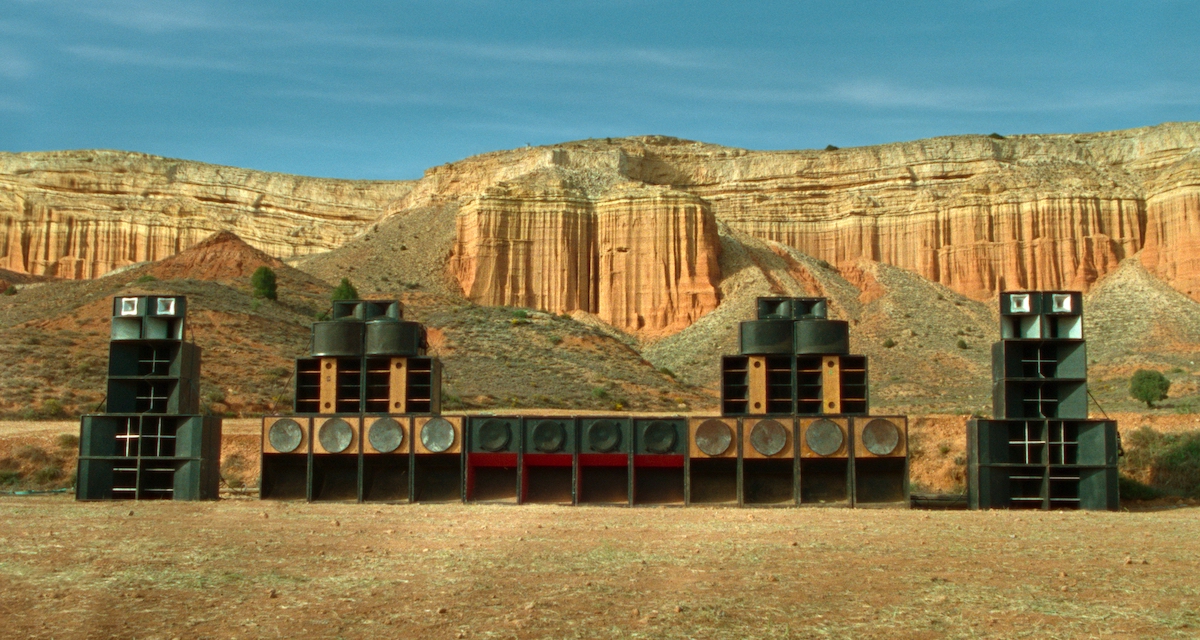
Sirāt is not a profound movie, but you may have a profound experience watching it. In that sense it honors its setting in rave culture, which involves a communal experience that strips away conversation in favor of pure feeling.
Oliver Laxe’s Spain-produced film, which is among this year’s Oscar nominees for Best International Feature, conveys a sense of intimate apocalypse in slow motion. It has a compelling premise, but proves willing to shatter storytelling conventions: you will not guess where this journey is going to lead.
In an opening sequence that feels like an EDM Koyaaniaqatsi, giant speakers are erected in the Moroccan desert for a dusty rave that proceeds as such events do — even as a middle-aged man (Sergi López) and his young son (Bruno Núñez) walk among the revelers, distributing flyers with the face of the son’s runaway sister.
When authorities break up the party, citing a vaguely specified national crisis, the father and son fall in with a found family of friends whose two giant vehicles are fueled up for a ride to the next rave. Hoping their missing relative will be there, father and son join the caravan with their humble van.

It could almost be the premise for a heartwarming family film, as the lovable outcasts bond with the desperate man and his charming child. Watch the dogs, though. Instead of perpetrating cute antics, the dogs tend to lie silently in their owners’ arms, absorbing their anxiety and radiating it back to the viewer. Even as the humans joke around, the dogs seem to sense this journey is not safe.
The singular quality of Sirāt lies in Laxe’s willingness to steer his conventional narrative (albeit in a striking setting) straight into the teeth of a world at war. Although not a shot is fired, Sirāt is a war movie that moviegoers anywhere might find all to easy to relate to — even if they’ve never considered buying a rave wagon.
Cinematographer Mauro Herce finds moments of striking beauty, but Sirāt does not romanticize the desert. It’s an unforgiving environment ill-suited to the conveniences of modern life, which seems kind of fun when you’re watching a laser show on a cliff wall and not so much when you’re trying to drive along the upper edge of that cliff wall.
Despite its serious subject matter, Sirāt is light on its feet. Co-writing with Santiago Fillol, Laxe eschews unnecessary subplots and backstory. (For example, we never learn any details about why the man’s daughter seems to have split with her family.)
That would be a problem if the film tried to lean on the interpersonal dynamics, but part of the film’s haunting effect is to suggest that when the going gets rough, it doesn’t much matter who chipped in for gas. Life itself becomes all that matters — and you dance, while you still can.
Images courtesy Neon
Leave a Reply