We’ve been here before — and by “here,” I mean in a lucid dream in Madrid.
Abre Los Ojos, Alejandro Amenábar’s 1997 movie remade by Cameron Crowe as Vanilla Sky (2001), has Eduardo Noriega grappling with the question of whether he would prefer to live in a perfect world he knows to be fiction or wake up to face the messy real world. In both the original and the remake, Penélope Cruz played the kind of woman men dream, more or less lucidly, of being with.
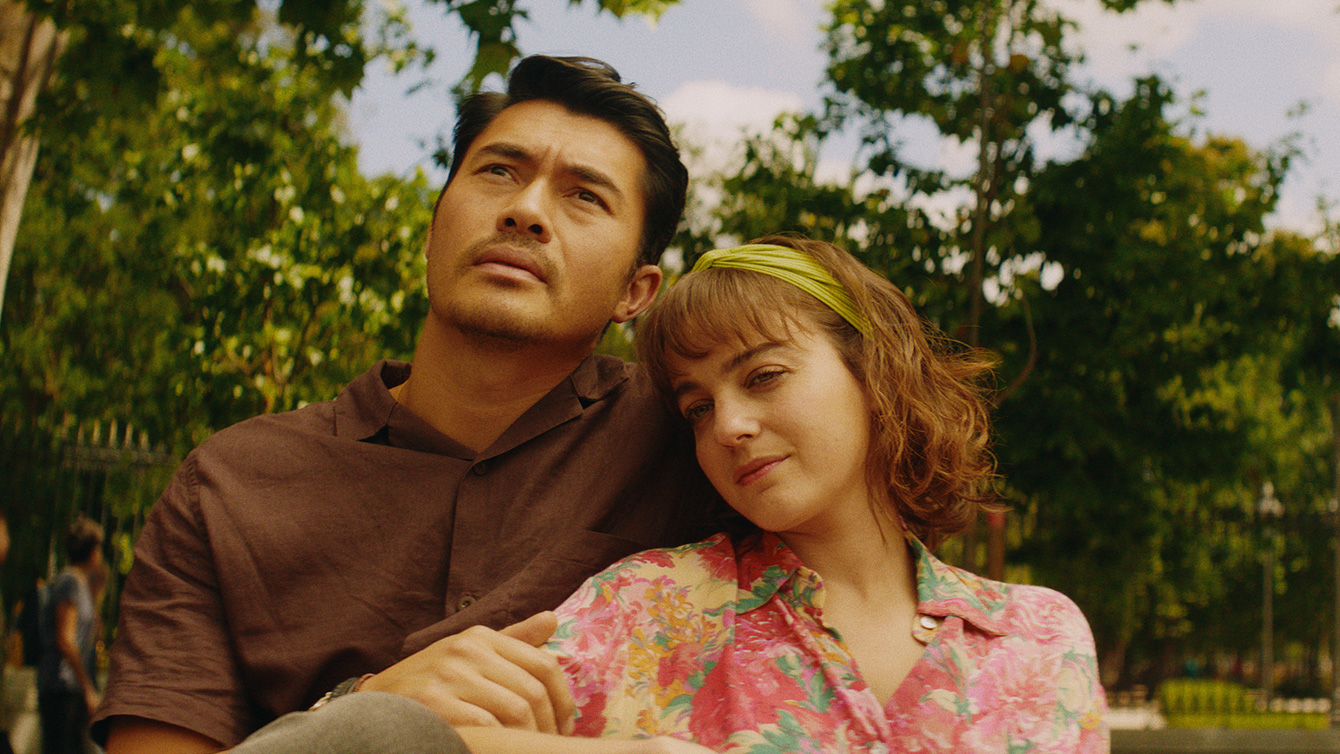
Daniela Forever casts heartthrob Henry Golding in the role of the dreamer. Beatrice Grannò, a breakout star from The White Lotus, is the dream girl. Again there’s a science-fictional mechanism giving the dreamer some measure of control over his dreams, again something goes wrong, and again the dreamer is faced with a decision.
The twist this time is that the dreamer’s decision doesn’t just concern himself: the longer Nicolás (Golding) dreams, the more Daniela (Grannò) develops a personality independent of Nicolás’s dictates. Whether this makes her a virtual replica of the deceased original Daniela, or someone entirely new, Nicolás finds himself grappling with whether he should use his dream power to bend her to his wishes.
The frustration of Daniela Forever is that writer/director Nacho Vigalondo favors style over substance, filling the movie with impenetrable plot twists and striking visuals (striking in that they hit you, if not always to much effect) but failing to ground his characters in the kind of detail that would make them come alive.

From the film’s very first moments, Nicolás is trying to recapture Daniela in his mind’s eye; shortly, we learn how her life was lost. What drew these two together, besides both being hot and bored at a party, never comes into focus as the film spins out the details of how Nicolás gains the ability to dream Daniela back to life.
Vigalondo’s most critical misstep comes early on, when Nicolás is presented with the spectacle of a living, breathing reincarnation of his lost love — yet one whose memories and personality have been wiped. Rather than recoiling, Nicolás delights in the phenomenon, leaving us with the impression that Daniela’s pretty face and stunning shape are truly all he missed about her.
It’s hard for the movie to come back from that, although Vigalondo does try by way of a woman (Aura Garrido) from Daniela’s past who appears in Nicolás’s present. Both central characters are thinly written; Golding compensates for this by overplaying, while Grannò underplays. Grannò’s performance works better, if only because she gives the impression of having understood the assignment, while Golding is left trying to squeeze tears from a stone.
By comparison, consider not only Abre Los Ojos but Eternal Sunshine of the Spotless Mind. Michel Gondry’s 2004 classic asks a similar question: if you could redo a relationship, what would you change? Screenwriter Charlie Kaufman, though, takes the time to really illuminate his characters’ connection, making us believe that both people would want to relive their relationship even if they knew it was doomed to fail.
Whatever made Daniela’s loss so devastating for Nicolás remains unclear over the course of this movie. Presumably if we really had Daniela Forever, we would figure it out, but in this case 113 minutes just aren’t enough.
Stills courtesy Well Go USA
Leave a Reply