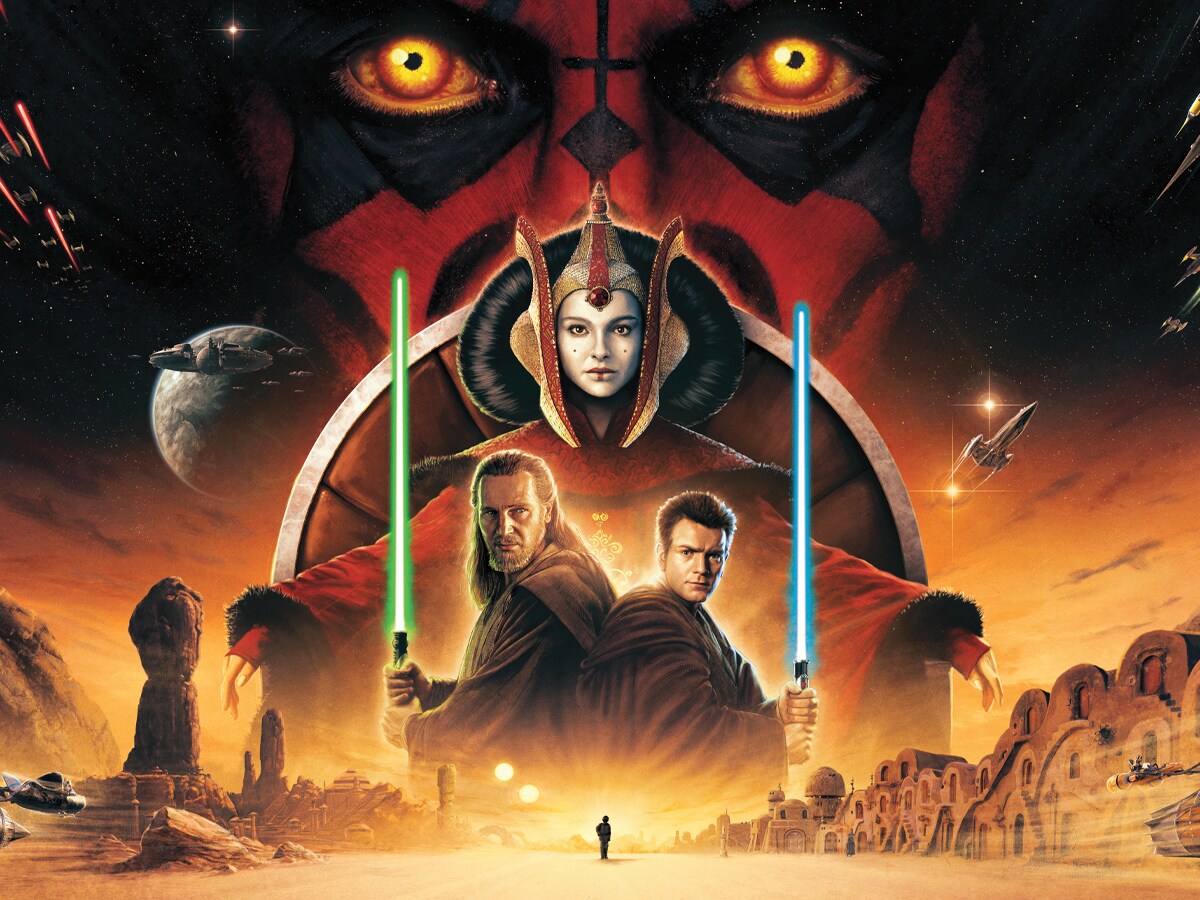
Oddly, I have no specific memory of seeing The Phantom Menace in theaters for the first time, though I must have seen it immediately upon its release. I was leaving a full-time job and getting ready to start graduate school, so I had a lot of real-life excitement to occupy me.
What I most vividly remember is the flood of merchandise, quickly marked down when the public’s appetite didn’t quite match expectations. As long as I had a landline, my phone was a Queen Amidala talking handset with buttons that would make the young ruler interrupt your phone call with “This is my decoy, my loyal bodyguard,” or “The Trade Federation has gone too far this time!”
It didn’t take long for fans from my generation, gen X, to decide that the prequels were the work of the revisionist, sentimentalist Special Edition George Lucas rather than the daring auteur of the ’70s and ’80s. Jar Jar Binks alone was enough evidence, for many, that the filmmaker had lost any sense of his audience. Little “Ani” seemed more sitcom than Sith Lord, and the coolest new character died at the end.
Twenty-five years later, Lucas has lived to see his vindication. The film rose to number two at the domestic box office in its anniversary re-release, despite the fact that it’s available for unlimited streaming on Disney+. The conventional wisdom now is that Jar Jar and Ani worked for the audience they were actually intended to please, millennial kids. Those kids have embraced the prequels as “their Star Wars” and are ready for a nostalgia trip.

The movie apparently worked on me as well, since I’ve already been back to see it twice during the re-release. I’ve always had a soft spot for the squishier side of the franchise — Return of the Jedi, Ewoks included, was “my Star Wars” — but as an active fan of the continuing space opera, I’ve been drawn in to the prequel era by the increasingly elaborate storytelling anchored in that timeline.
J.J. Abrams looked like a genius after The Force Awakens thrilled audiences of all generations; in my own 20th anniversary assessment of the prequels five years ago, I wrote that “[Hayden] Christensen walked so that Adam Driver could fly.”
At this moment, though, with The Rise of Skywalker having underwhelmed as the last theatrical installment, it’s Dave Filoni who holds the keys to the Star Wars kingdom. The Clone Wars animated series Filoni made with George Lucas not only provided a template for how Star Wars could work on the small screen, but hugely expanded on the world of the characters seen in the maligned theatrical prequels.
The Phantom Menace re-release even comes with a preview of The Acolyte, a series set well before the prequels — underlining that, despite a movie following sequel heroine Rey being under development, the immediate future of Star Wars storytelling has much more to do with events preceding and immediately following the original trilogy than with anything in the reboot-style sequels.
So Phantom Menace holds continuing interest, whether for kids who haven’t seen it, thirtysomethings who saw it as kids, or fortysomethings like me who just read an entire novel unpacking the personalities of the Jedi Masters glimpsed in Episode I council meetings. That said, how does it hold up as a movie? Let’s take a look at the three main dings against The Phantom Menace when it was first released.
The ethnic stereotypes

In retrospect, it’s kind of amazing that Lucas avoided anything as hoary as the Gungans or the Neimoidians in the original trilogy, given that the Flash Gordon serials featured “Ming the Merciless” as a major antagonist. In 1980, the year of The Empire Strikes Back, Ming not only remained a problematic Asian stereotype but was played by a white actor, Max Von Sydow. That actor’s death in an early scene of The Force Awakens seemed symbolic of the sequels’ earnest, if not entirely successful, commitment to diversifying their casts.
Very recent Star Wars media have struggled mightily to rewrite the DNA of a franchise where virtually any accent means a character is coded as “other.” The incorporation of actual sign language experts into the development of Tusken Raider language in The Book of Boba Fett is a particularly impressive example of this progress. We can take Lucas at his word in saying he never meant to invoke harmful ethnic stereotypes with characters like Jar Jar, the Neimoidians, and Watto while acknowledging that, in fact, he did.
Not exonerating Lucas, but providing essential context, is the fact that Jar Jar is now commonly considered from the perspective of Ahmed Best, the actor who played the character and was deeply wounded by the opprobrium. It’s worth watching behind-the-scenes footage of Best, an unknown actor asked to play opposite Liam Neeson, Ewan McGregor, and Natalie Portman while wearing the ridiculous getup that served to mark the space where Jar Jar would be digitally inserted.
Before Andy Serkis was crowned the Brando of motion capture, before anyone had any idea the process would actually work, Best committed to the bit and delivered a performance that still makes kids chuckle. Particularly now that Lucas has sold the franchise and doesn’t need to be personally defended as the infallible font of the entire Star Wars universe, many fans have found it possible to respect Best’s achievement without dwelling on problematic aspects of a character who was never again prominent in the franchise.
The visual effects

Older fans who were already indignant about Lucas’s digital retooling of the original trilogy were never going to be thrilled by the boundary-pushing use of digital effects in the prequel trilogy. Today, ironically, it’s precisely the advances in digital effects that make The Phantom Menace look less, so to speak, jarring than it did in 1999.
Viewing the movie in light of films that make much more highly developed use of digital technology — a trailer for Kingdom of the Planet of the Apes is playing alongside the Phantom Menace re-release — vindicates Lucas’s intuition that digitally created worlds would be the way of the future. Fans of effects films today appreciate the Star Wars prequels the way that the original trilogy’s effects fans venerated Ray Harryhausen.
At the same time, moving-image media are now awash in low-level digital effects that can be done cheaply and still leave The Phantom Menace looking pretty good. Consider all the CGI characters in advertisements, or the digital snow that’s sprayed across made-for-TV Christmas movies. Digital effects that are simply good enough are now ubiquitous, so we don’t judge them as harshly as audiences did in the ’90s.
That said, there’s a reason the recent Star Wars live action movies and TV series have gone out of their way to use practical effects — particularly practical creature effects — wherever possible. It was key to the wow factor of the original Star Wars that everything felt palpably real. Even if the cantina aliens’ masks weren’t particularly articulate, you knew you weren’t looking at cartoon characters. Similarly, the battle scenes didn’t have anything to pull you out of the illusion that you were watching actual vessels move through space.
Although the Phantom Menace pod race is still regarded as one of the prequels’ most effective sequences, I still can’t get over the caricatured CGI aliens who Anakin competes against — and even less so, the digital Jabba who has absolutely none of the imposing presence of the grotesque puppet seen in Return of the Jedi.
The storytelling

This is the most compelling basis for any real critical reappraisal of The Phantom Menace. In 1999, Lucas was reviled for devoting opening-crawl real estate to “the taxation of trade routes to outlying star systems” and having key plot points turn on parliamentary proceedings (“I move for a vote of no confidence in Chancellor Valorum’s leadership”).
The decision to delve into galactic politics was already looking sounder by Episodes II and III, when it became increasingly clear that Lucas was crafting an allegory to the rise of real-world authoritarianism — one that was made chillingly timely by George W. Bush’s abuses of power in the wake of 9/11. The expansion of the prequel stories into The Clone Wars and later series further vindicated Lucas: politics might not do much for space opera, but it provides fertile ground for complex episodic storytelling.
Sharpening the real-world analogy that started as a vague (indeed, oft ignored) Vietnam War parallel in the original trilogy also lent weight to the expanding world of Star Wars storytelling. From clones with conscience (The Bad Batch) to heroes who aren’t afraid to exact collateral damage for a righteous cause (Andor) to warriors who abandon their armies in service of higher goals (Ahsoka), Star Wars stories today explore a wide range of meaningful character choices. Give Phantom Menace credit for digging that foundation, even if it also dug some unnecessary holes — and fell into them.
On a more granular level, Episode I provides continuing grist for the argument that Lucas was always best not as a director but as a vision guy working with a strong director and screenwriters (see: The Empire Strikes Back, Raiders of the Lost Ark).
Consider, for example, the way Lucas treats Anakin’s departure from Tatooine. This is a key character development, as the script seems to acknowledge. The boy’s decision to leave his only non-microscopic parent in a situation of involuntary servitude, subject to any kind of use and abuse, will haunt him with guilt and fear…leading to anger, yada yada. (The Jedi’s ready assent to this troubling circumstance, in the name of “bringing balance to the Force,” has been explored in later canon media.)
Pernilla August, the fine veteran actor playing Shmi Skywalker, is there for it. John Williams is ready with a sweeping cue. Even Jake Lloyd, no Milo Machado-Graner, is ready to do his darnedest. And yet, Lucas lets them all down by dropping Anakin’s one moment of hesitation into the edit with absolutely no build. Imagine what Spielberg might have done if given five more minutes, one more minute — even 20 more seconds to establish the child’s emotional turmoil. Lucas, in essence, simply declares it to be so and has Lloyd, out of nowhere, tell his mom he can’t bear to leave her. This Anakin obviously can, and does.
It’s not that Lucas is constitutionally incapable of establishing this kind of tension. In fact, he did so in the original Star Wars, where Luke’s bond with Ben was far more effectively set up: we saw Luke’s tension with his uncle, his longing for what Kenobi represented, and then his grief at the Jedi’s sudden loss. The fact that Anakin’s arc is stunted in The Phantom Menace speaks to a failure beyond just awkward effects. There’s a humanness to the original trilogy that the prequels found too little, too late.
So, no, Episode I isn’t entirely redeemed. What can be said, though, is that Lucas’s boldest and most farsighted choices can be better appreciated at a remove of a quarter-century. Presumably the movie will seem like a work of absolute genius a long time from now, in a galaxy far, far away.
Leave a Reply