
People who do not know anything about linguistics love to educate others on how incorrect their use of language is. “Your child is ‘doing good?’ Oh you peasant, I think you mean your child is ‘doing well,’ because his performance of ‘doing’ is always ‘well done,’ you poor, uneducated person who ‘does poorly’ at life.”
This has quickly happened in reference to the pronunciation of the acronym GIF, now that its creator has declared that it’s pronounced like the peanut butter brand favored by choosy (and we presume, sexy, moms). Here are 3 linguistic reasons why what he says does not matter at all.
1. People who invent words – or more specifically, the concepts that words signify – do not get to determine how those words are pronounced forever.
This is a dumb metaphor but it should get you thinking. Let’s say God invented trees. God cannot drop down from heaven in a series of lightning strikes and say, “Why do you call them ‘trees?’ They are supposed to be referred to by the Hebrew word ‘[blah blah].’ You people must immediately stop using the word ‘tree’ forever, ignoramuses!
2. Words are a social agreement.
A simple way to understand this is to read the book Frindle, where some kids decide to start calling pens “frindles,” to the point where frindle begins to actually signify “pen” in a useful way and eventually makes it into the dictionary. The complicated way to understand this is to study semiotics, an at-times trying subject favored by really obtuse European guys. The first thing you’ll learn is that words are signs, which consist of a signifier (the word) and a signified (what it refers to). These signs are a result of an intersubjective agreement between people who determine what a word will refer to and agree to use it that way. i.e. “When I say ‘door,’ I mean that open-y thing on the other side of the room.”
One of the main guys, Saussure, favored studying spoken language, probably because spoken language often tends to reflect these intersubjective agreements more than written language, which sometimes superimposes grammatical rules that people resist agreeing upon. (You could argue that we have intersubjectively agreed, as Americans, that it is fine to use adjectives, rather than adverbs when the adverbs don’t make sense to us, like in my intro example about ‘doing good’ vs. ‘doing well.’ Feeling bad does not mean you are doing a bad job at feeling, you know?)
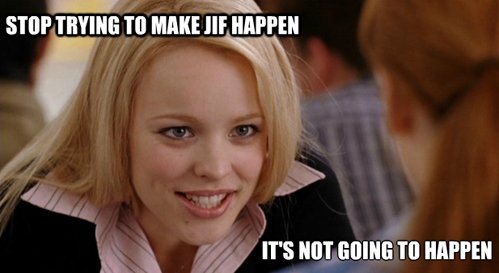
Sometimes words that people try to invent and get other people to agree to use are not successful, like in Mean Girls when Regina George tells Gretchen “quit trying to make fetch happen.”
We have already made an intersubjective agreement, as a society, to pronounce GIF with a hard G, and its creator Steve Wilhite is late to the party.
3. There is no “wrong” if words are fulfilling their function of signifying a signified object or concept.
I hate when people correct one another’s language usage for being “newfangled” or corrupted because corruption is how most language is created. For example, English could be considered a corruption of Germanic languages colliding with Romance languages, cemented by generations that found logical ways to structure corrupted, “newfangled” words grammatically. Language likes corruption so much that it even makes it possible for something to mean its opposite, if people like saying it that way enough. For example, the phrase “I could care less.” If you could care less, it technically means you do care, but this phrase actually means you totally don’t care at all.
GIF pronounced with a hard ‘g’ is already successfully being used to refer to graphical interface formulas, and attempts to change already successful signifiers often translate into annoying ways for people to nag other people about their language use, rather than actual, more ‘correct’ terms.
We probably started pronouncing it with a hard G to differentiate it from the peanut butter or something. Either way, it’s already been intersubjectively agreed upon, and that is what matters most in language. If you want to keep pronouncing it that way, don’t let people tell you that you are incorrect.
Note: I started a new blog about language called Linguisticated, where this was originally published. I might share things from there here now and again if they seem relevant to a wider audience.

Leave a Reply