In my current seven-day-a-week job, I barely even notice when Friday arrives—but when I was in early grade school, Fridays were almost unspeakably wonderful. Not only did Friday signal the beginning of a two-day period during which I wouldn’t have to attend the school I so detested (I detested all of them, until college), the last couple of hours of the day were taken up by film-watching. This being the early 80s and my school being Catholic, we watched actual films run through a projector. I vividly remember sitting on the carpet, leaning back on my hands, and having a feeling that in adult life is most often associated with happy hour. I enjoyed all the films we watched, but one film became perhaps the single most searingly memorable film-watching experience of my life.
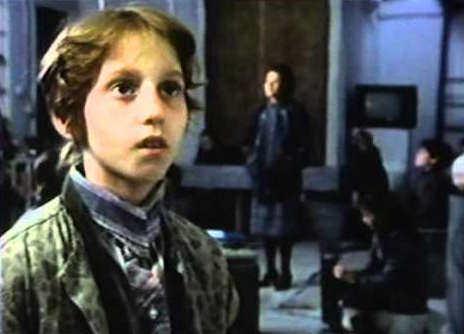
It was All Summer in a Day, a 1982 adaptation of Ray Bradbury’s 1954 short story. The story is set on Venus—a version of Venus that’s inhabitable by humans, but where it constantly rains except for one hour every seven years. In the story, a class of children prepare to enjoy their rare hour of sunlight; particularly excited is young Margot, who was born on Earth and remembers a world where the sun shone every day. Just as the sun comes out, though, the children shove Margot into a dark closet, where she remains tragically trapped while her classmates cavort in the sun.
S. Murdock Donaldson’s screenplay expands on the very short story, and makes it slightly less bleak. Though the essential fact of Margot missing the sun remains, in director Ed Kaplan’s film the burden of guilt falls heavily on one particular bully—rather than being equally shared by the entire class—and there’s a scene of atonement at the end, where the children present Margot with flowers they gathered in a sunny field.
The entire 25-minute film is now available on YouTube, and I just watched it for the first time since I sat in that school basement in Duluth almost 30 years ago. My first surprise was that the main character is a girl—I’d always remembered the character as having been a boy. Having been bullied myself, I think that I so strongly identified with the character that, in my mind, she became a boy like me. In the wake of Ray Bradbury’s recent death, I decided to contact the actress who starred in the film and ask her to share her memories.
Her name is Reesa Mallen, and she was 11 years old when the film was shot; she’s now living in Madison, Wisconsin, working as an art director on photo shoots. It turned out that I wasn’t the first one to reach out to Mallen after Bradbury’s death. “My mom just called me at work,” she said, “and I knew it was something important, since she knows I’m very busy during the work day. She said, ‘Ray Bradbury just died. 91 years old.’”
Mallen says that Bradbury was consulted about the making of the film, but wasn’t on set; so the first and only time she met him was at the film’s public screening, at the Mann Westwood theater in L.A. “I was nervous to meet him,” she remembers, “because he was spoken of as an icon. I remember meeting him after the movie screening—he was a big guy. He was so nice; he said ‘You did a wonderful job’ and gave me compliments on and on. I said something about how my birthday was coming up, and he asked when it was. I said, ‘August 22,’ and he said, ‘That’s my birthday too!’ So we shared that. He was just so warm and kind.”
The young actress was completely different than her somber character, but she impressed the filmmakers at her audition. “I was asked,” she remembers, “to improvise the way I would act if I was locked in a closet and kept away from something I wanted very much. I took that to heart for some reason; I just really got into it and had a meltdown and started crying.”
Before and after All Summer in a Day, Mallen’s acting experience was limited; she went on to appear in episodes of Our House and The Bronx Zoo in the 1980s, but didn’t continue acting as an adult. She trained with the noted teacher Diane Hardin at the Young Actors Space, a premier school for young actors—Molly Ringwald, among others, studied there. Most of the All Summer in a Day cast members were classmates of Mallen’s, and she says the unremittingly bleak tone of the film belies the fun everyone had on set. (The film was shot at the decommissioned Fort MacArthur military base in San Pedro.)
“It was a fun little posse,” she says. “We almost all knew each other. There were so many times on set when we just couldn’t stop laughing, no matter what we did. The scene where we’re by the windows and [actor] Keith [Coogan] is hanging on the little ladder— ‘Why do you hate me?’ ‘You’re such a know-it-all’ —then you see my little face in the circular window, they had to shoot about ten times because I could not keep a straight face. It was a blast.” Mallen ended up dating one of the actors in the film, a blonde boy named Jesse. “He came to my house and my mom took us to see the [touring] Broadway production of Annie—that was one of our dates.”
More glamorous was costume designer Michael Kaplan, then a rising star who’s now acclaimed for his work on films including Blade Runner, Flashdance, Fight Club, and J.J. Abrams’s 2009 Star Trek. “He was absolutely gorgeous, just beautiful—like a poster from Teen Beat magazine.” Mallen mentioned something about Kaplan to someone who explained to her that Kaplan dated men rather than women. “That,” she says, “opened up a whole new world to me.”
One of the most memorable moments in the film, says Mallen, was improvised. “I recited my little poem about the sun— ‘The sun is like a flower that blooms for just one hour’ —and the teacher said, ‘That’s lovely, Margot. Did you write it?’ I replied, ‘Yeah! It’s a poem!’ I don’t know why, but the entire crew busted up laughing, knowing that wasn’t the right line. Then they said, ‘You know, let’s keep it in.’”
The film was shown often on HBO in the 1980s, and Mallen grew up being sometimes embarrassed about it. In the film, “My teeth were pretty jacked up, and my hairstyle made it look like I had a mullet, and then there’s that scene where I was standing in front of the sunlamp [in a bikini] and I was such a skinny kid.” But she’s continued to hear from people over the years. “I’ll randomly get e-mails from people, asking, ‘Are you the one who was in that film?’ It was such a teeny, small film—but it had an impact on a lot of people.”
30 years after the release of All Summer in a Day, the national debate about bullying has made the film especially resonant. Poignantly, says Mallen, she shared some of Margot’s experience during the filming of the scene with the children playing in the field. “That day I wasn’t on the call sheet, and I felt left out—I was in every other scene. All my friends were out playing in the sunny field, and I felt sad. ‘Can’t I just go to watch?’ I asked. Art became life.”
The elemental horror of All Summer in a Day is its dramatization of the way that people can carelessly hurt you in a way that can’t be undone. That’s a truth most often associated with adult relationships—betrayals, stinging words—but children can be hurt that way too, by other children. I now wonder if the reason the film has stuck so strongly with me over all these years is that, in a world that regarded bullying as merely a harmless and inevitable fact of childhood, All Summer in a Day understood. Ray Bradbury understood.

Leave a Reply