
Today my writerly friends have been gleefully tossing around a blog post by The New Yorker‘s Alex Ross, in which Ross looks back and shakes his head at “my Derridean period,” going so far as to present an extended quote from a deconstructionist college essay about The Shining that’s actually so well-written, if comments were enabled on the New Yorker site, Ross would surely be called out repeatedly on his #humblebrag.
By the time I started grad school in sociology in 1999, Derrida, Foucault, and their intellectual bedfellows had been clustered together into a discipline called “Cultural Studies,” and I guess it’s my own #humblebrag to say that I was never much in thrall to any of them. I was jealous that they got to publish entire books dissecting TV series and 19th century novels in social context, but I was always annoyed that their analyses were primarily of the armchair variety.
This is not to dismiss the amount of research and expertise that scholars in cultural studies bring to bear on their monographs, nor is it to assume that Derrida, Foucault, or any of the other thinkers to be found in the Cultural Studies section of your local university bookstore would necessarily find that to be to be the most appropriate shelving. But the beast that is Cultural Studies today doesn’t care: it wants them anyway. Per Wikipedia: “Cultural studies approaches subjects holistically, combining feminist theory, social theory, political theory, history, philosophy, literary theory,media theory, film/video studies, communication studies, political economy, translation studies, museum studies and art history/criticism to study cultural phenomena in various societies.”
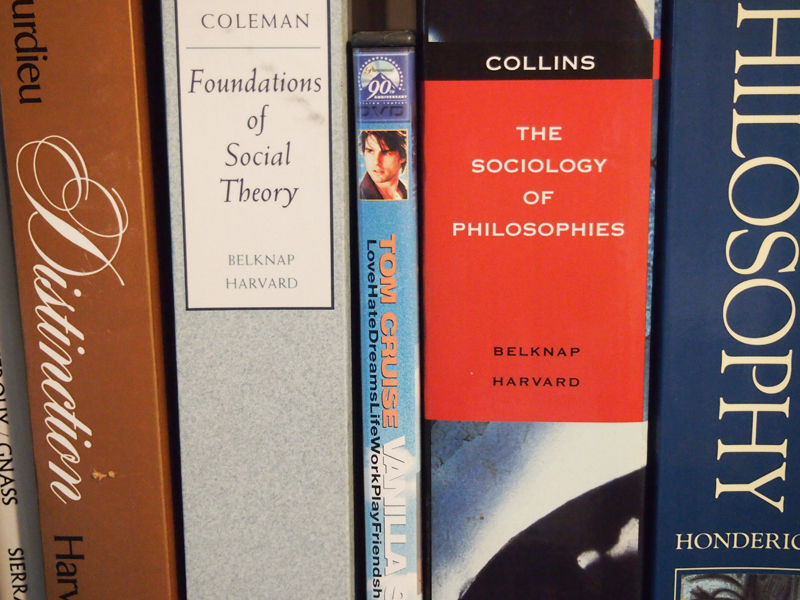
Any academic discipline stands on the shoulders of its forerunners, but the most useful disciplines incorporate those forerunners into a fresh synthesis that yields fresh insights, inspiring new questions. Cultural Studies just throws a lot of provocative ideas into the kitchen sink and invites people to think high-mindedly about low culture. (If you even think about running at me with one of the several long histories of the concept of “low culture,” I’m warning you that I’m ready to defend myself—not intellectually, but physically—with my paperback edition of The Sociology of Philosophies.)
If the human brain is the most complex thing known to exist, then human culture—the interaction, over time, of bilions of human brains—is orders of magnitude more complex still. So it’s easy to find something to say about culture, but it’s difficult to prove that something right or wrong. You can spend a lifetime shuffling through texts (written, visual, ideological, or whatever) to find new layers of meaning, assumption, and intention beneath them, but to what end? Ross eloquently describes the poststructuralists as “virtuosos of doubt,” and the best work in this tradition reads like a grand, seductive conspiracy theory: nothing is as you assume! You think you’re pulling strings, but you’re actually being pulled! Trust no one!
When I’d tell people of an academic bent that I was studying the sociology of culture, they’d often come charging through that conversation opening with their Derridean (or, more commonly, Foucaultian or Bhaban or Lacanian or Gramscian) knives drawn, fired by a weird confidence that some obscure anecdote regarding the invention of indoor malls or the distribution of pamphlets in 19th-century Berlin holds the absolute key to understanding Britney Spears. Someone’s behind it all! But who? As with Chomsky’s political, er, theory, Cultural Studies texts typically end up chasing their own tails until they turn into butter for the turtlenecked class to spread, scowling, on their scones.
The Cultural Studies project has been a notable success at being a success, but has it actually explained anything? I mean really explained it, not just detailed the concrete evolution of this, that, or the other medium or genre or text. As sociologists, we read Foucault and Derrida and Gramsci and used their ideas to inspire empirical investigations with real, testable hypotheses that could be proven right or wrong. If a text doesn’t provide ideas that you can test—systematically, scientifically test, not just dig up illustrative anecdotes regarding—then what’s its use?
Well, you can aways use it to prop your door closed. But don’t worry—I won’t try to force my way in. Enjoy your scone, and your Spears.


Leave a Reply