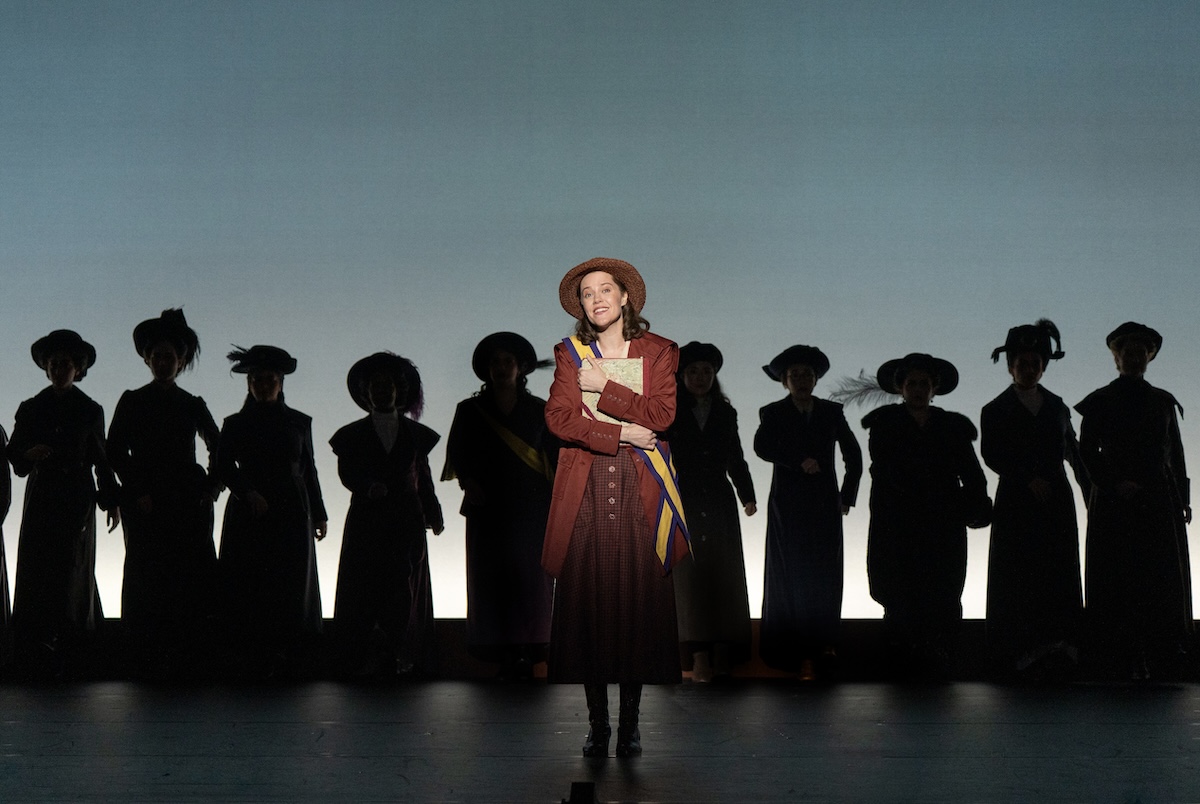
Wow! This one word describes my granddaughter’s reaction to the touring production of Suffs, which is currently playing at the Orpheum Theatre in Minneapolis. Everything about this show works: performances, songs, costumes, sets, lighting, and sound.
Directed by Leigh Silverman, Suffs dramatizes the historical events leading up to the 1920 ratification of the 19th Amendment giving women the right to vote. After opening off-Broadway in 2022, Suffs premiered on Broadway in April 2024. It won Tony Awards for Best Book and Best Score.
The book, music and lyrics were written by Shaina Taub, whose cohesive voice holds the show together. (Taub also starred in the original Broadway production.)
The touring cast is uniformly excellent, so it is hard to single out any one performance. From the starring to the supporting roles, each cast member made a meaningful contribution. However, I would be remiss in not mentioning Maya Keleher as Alice Paul, the idealistic younger woman who provides the catalyst to complete the long battle for voting rights for women. Her enthusiasm and singing talent successfully carry a complex story.

While the show begins in 1913, the campaign officially began in Seneca Falls, New York in 1848 with a proclamation that all men and women are created equal, with the same rights. In 1869, the National Woman Suffrage Association was formed. A plan was adopted to fight for change on a state-by-state basis.
In 1913, the leader of this movement was Carrie Chapman Catt (Marya Grandy). The show opens with the song “Let Mother Vote,” which was the non-threatening persuasion being used. (“We’ll deploy domestic skills to cure domestic ills, so mister, won’t you please let Mother vote?”) Joining the fight is Alice Paul, who at age 27 believed that while some progress had been, made it was time for decisive action. She organized the first-ever Women’s March on Washington, held in 1913 the day before Woodrow Wilson’s inauguration. The marchers called for a federal constitutional amendment to secure the right to vote for women.
Working tirelessly, Paul leads the fight for six years. In 1917, the first-ever silent protest was organized outside the White House gates. Over a period of two and a half years, more than 2,000 women protested there. During this time Paul and other picketers were arrested and jailed. News of the hunger strikes they conducted, and their mistreatment in prison, eventually reached the public and forced Wilson to support the suffrage bill. The bill was approved by both houses of Congress in 1919; it then had to be ratified by 36 states to become law.

The song “A Letter from Harry’s Mom” tells of the telegram sent by Phoebe Burn to her son Harry Burn, convincing him to do the right thing (“Now your own little daughter is nearly three. What do you want her future to be?”) and cast the deciding vote for Tennessee to become the final 36th state.
Even after this, Suffs reminds us that the Equal Rights Amendment, proposed in 1923 by Paul and fellow suffragist Crystal Eastman, still has not become law. The League of Women Voters were in the Orpheum lobby with information. Many of the audience members were wearing ERA buttons, shirts, and sashes.
The play ends with the song “Keep Marching,” which speaks to where we are today as a state and as a nation. (“Progress is possible, not guaranteed. It will only be made if we keep marching…”) The audience at Tuesday’s performance responded enthusiastically to the many lines in the show that resonate with us today.
Suffs runs through April 12. Treat yourself and see it if you can.
Top image: Maya Keleher (Alice Paul) and company. Center: Danyel Fulton (Ida B. Wells), Trisha Jeffrey (Mary Church Terrell), and Victoria Pekel (Phyllis Terrell). Bottom: Monica Tulia Ramirez (Inez Milholland). All photos by Joan Marcus, courtesy Hennepin Arts.
Leave a Reply