I recently re-read Roger Ebert’s review of The Jerk (he was unamused), and his argument has stuck with me. To paraphrase: the best comedy comes from characters whose motivations we understand and can empathize with when they find themselves in funny situations. If a filmmaker just cuts straight to the funny situations, we have nothing to do but shrug.
In The French Italian, writer-director Rachel Wolther at first follows the former approach, drawing us into a relatable predicament involving a New York couple and their obnoxious downstairs neighbors. As the screw turns, though, Wolther loses the thread and loses our interest.
Like the recent Twinless, The French Italian bets big on an implausible premise that it strains to sustain. Wolther, at least, discards any premise of subtle character drama: The French Italian is a situation comedy at feature length, with characters drawn in quick and broad strokes.
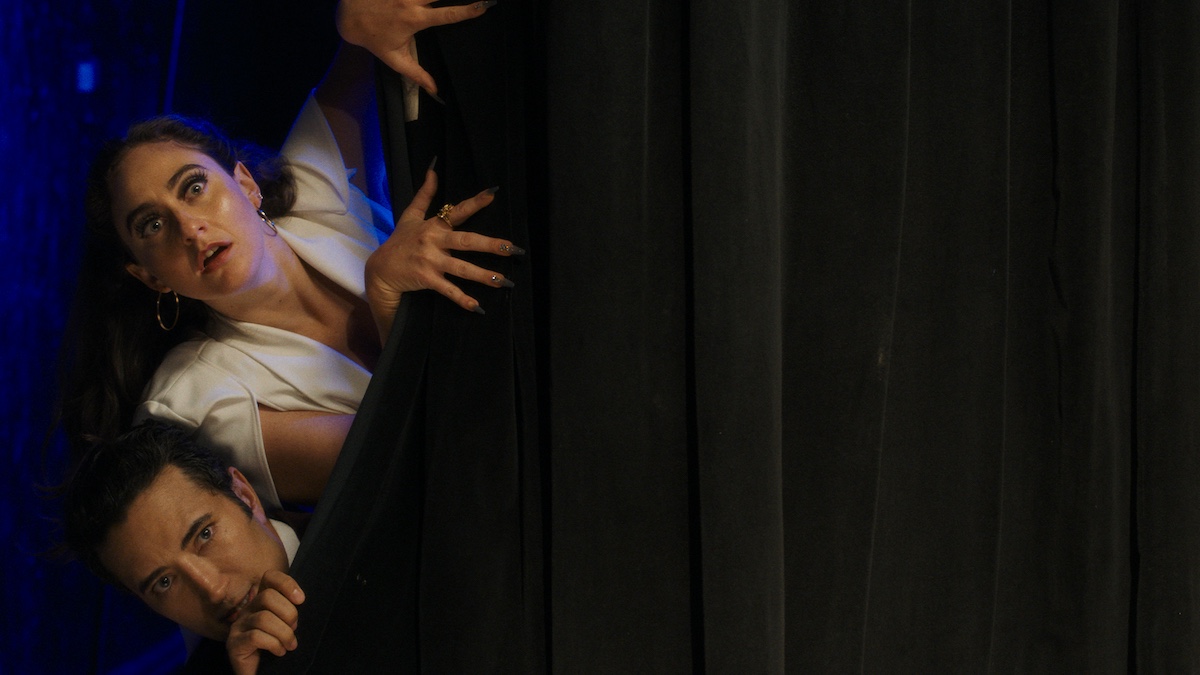
Valerie (Catherine Cohen) and Doug (Aristotle Athari) have a sweet situation, happy in their DINK lifestyle with a rent-stabilized apartment. Until, that is, their downstairs neighbor Jordan (Jon Rudnitsky) enters a tumultuous relationship with an aspiring actor, Mary (Chloe Cherry), and her home karaoke machine.
On a dare, after fleeing to the suburbs, Doug and Valerie cast Mary in a play they concoct to both mock her and probe for the dirty details regarding her relationship with Jordan. The unlikely heel turn is encouraged by Wendy (Ruby McCollister), an actor friend who starts taking the prank so seriously that Valerie and Doug start to wonder if they actually have a hit on their hands.

The film’s first act, framed by a party at which Valerie and Doug are describing their situation, is crisp and amusing. Wolther nails the absurdity of moments like the one where Doug and Valerie lie in bed, wishing their neighbors would shut up but also hanging on every word of the relationship drama.
The French Italian starts missing opportunities, though, when it moves into the rehearsal space for the initially nonexistent play. We’re given to understand that what Valerie and Doug have written is an amateurish relationship drama drawing on details from Mary’s life with Jordan, but the movie just glosses that rather than digging into the rich comic potential of an actor taking a role that turns out to be a thinly fictionalized version of her own life.
If we had more of a sense of what was actually in the play, it would be easier to relate to the writers’ growing sense of ownership and pride. In the absence of any detail about the stage production, Doug and Valerie are reduced to avatars of mere vanity, and become less interesting as a result. Wolther doesn’t expect us to weep at their comeuppance, which is gratifying — except that she goes too far and leaves us without any sense of investment in these characters or their decisions.
That said, Wolther has a sure hand with tone, and editor Tessa Greenberg helps the material hit its comic beats without sagging. Athari and Cohen find a nice chemistry as a witty duo not overburdened with empathy. Cherry and, as her onstage costar, Ikechukwu Ufomadu have more thankless roles given that the film isn’t particularly interested in their play or performances.
If nothing else, pro-urbanists can take heart at The French Italian, which argues that even living above an unstable couple with a karaoke machine is better than taking the New Haven Line home to dead silence.
Images: Catherine Cohen and Aristotle Athari (top); and Chloe Cherry (below) in The French Italian. Courtesy Level 33 Entertainment.
Leave a Reply