Ever since I was old enough to read chapter books, my all-time favorite book has remained the same: The Lion, the Witch and the Wardrobe by C.S. Lewis. It has always struck me as a perfect fantasy, full of wonder and fascination.
Although I was raised Catholic, I was surprised to later learn that the book is a Christian allegory. As a child, I simply took it as a marvelous invention. Perhaps I failed to make the connection because the powerful, complex Aslan seemed so far from the judgmental Christ who had come to seem almost mundane through his classroom-wall ubiquity.
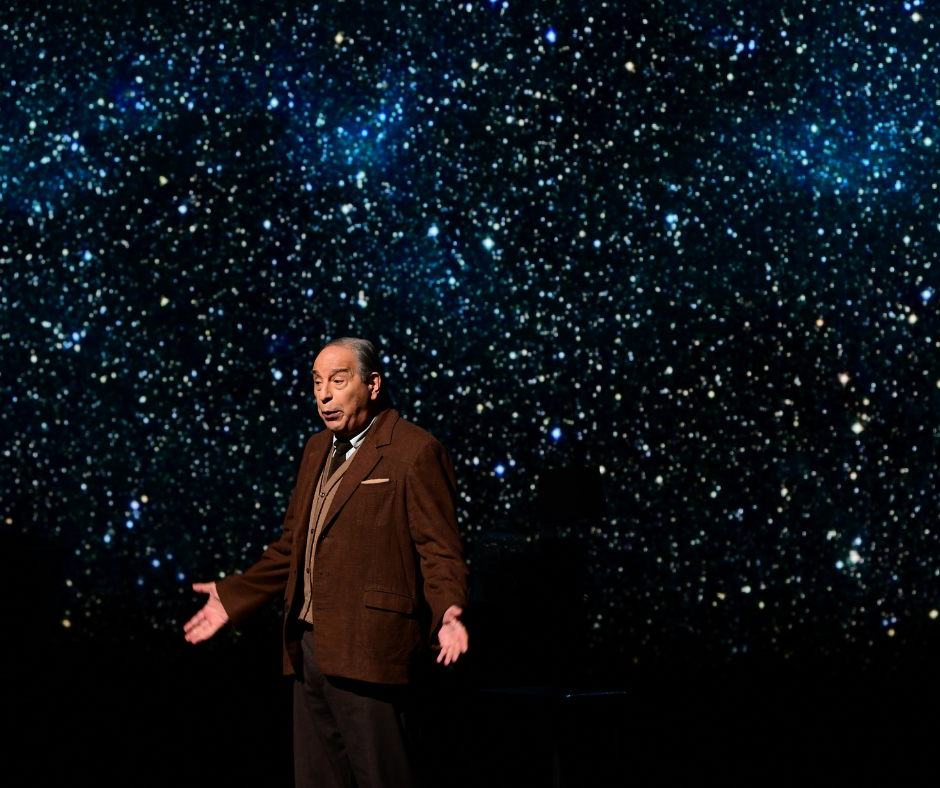
As actor/writer Max McLean points out, in character as Lewis during his one-man stage show Further Up & Further In, Aslan does not promise safety or comfort. Nor does he micromanage his followers’ lives. He merely sits in power, waiting and hoping the beings of Narnia will make a leap of faith: the only choice that can possibly save them.
C.S. Lewis On Stage: Further Up & Further In debuted in 2022 as a follow-up to a previous play about Lewis’s conversion to Christianity. Further Up & Further In is not a biographical play in the traditional sense; we learn fairly little about Lewis’s life beyond establishing that he became widely known as a Christian thinker during the World War II era.

Instead, the play examines some of the ideas and arguments that Lewis advanced during his career as a public theologist. His fiction writings get only glancing mention, despite their enduring popularity; McLean draws viewers into topics like the question of human origin, the provability of prayer, and the significance of Revelation.
It’s hardly the most marketable material to hit the 21st century stage, but McLean has found eager and appreciative audiences particularly among Christians hungry for humane, open-minded discussions about faith. While Lewis’s logical case for belief is unlikely to convince today’s skeptics — it’s just a little too convenient that a man steeped in Western culture would discern through pure reason that Christianity must be among all comers the one, true religion — his conviction that sincere faith is strong enough to bear critical questioning is a balm in this era of renewed book-burning and intolerance.
The Most Reluctant Convert was adapted into a 2021 movie; Further Up & Further In is now available on video in the form of a film documenting the stage production. Director Ken Denison avoids distracting flourishes and keeps the focus on McLean, aside from cutaways to visuals that appear onscreen during the stage production. The projections — Biblical scenes, starscapes, and the like — are the cheesiest aspect of a show built on a well-crafted script and restrained set, but it’s hard to fault the production for adding an element of visual interest when the show is essentially one man talking about theology for 80-odd minutes.

Lewis and McLean are well-served by the film, which brings one of the 20th century’s most beloved figures into living rooms wanting to welcome him. Never as cinematic as his friend J.R.R. Tolkien, Lewis has benefited less from adaptations of his fiction than from films touching on his poignant life — notably the Oscar-nominated Shadowlands (1993), starring Anthony Hopkins as Lewis.
Even as a nonbeliever, I still enjoy Lewis’s writing for its insights into human nature. McLean doesn’t shy away from Lewis’s appealing vulnerability, admitting that he simply yearns for something greater than this world can ever deliver, allowing for the supposition that there is a real element of choice in his belief. If we all have such a yearning, it’s up to us to decide what to do with it.
One thing Lewis demonstrated is how little distinction there is between the power of faith and the power of story. By incorporating both fictional narratives and the true narrative of his own life into his theology, Lewis opened doors that might lead to belief — or might simply lead to suspended disbelief. One has to imagine that Lewis would consider either outcome a win.
Images: Allen Clark Photography
Leave a Reply