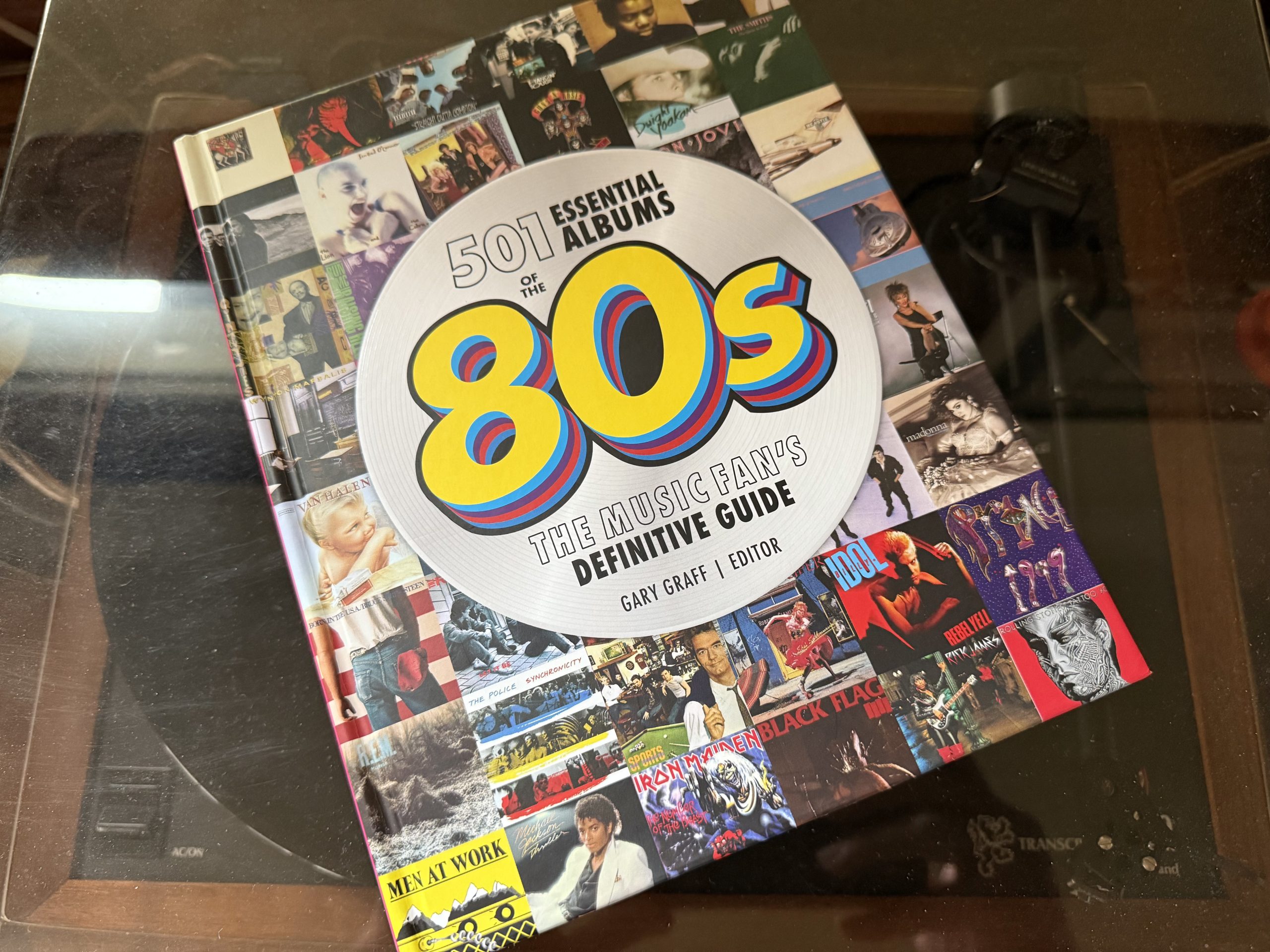
Choosing an adjective for the title of your list book may not seem like a significant part of the process. “Essential”? “Best”? “Greatest”? What’s the difference?
As the author of 100 Things To Do In Duluth Before You Die, I appreciate the passive-aggressive framing of books like 1,001 Albums You Must Hear Before You Die. You only need to listen to each album once, but…you know, once. Before you die. It’s going to happen. Just saying.
In the title of 501 Essential Albums of the ’80s, though, the adjective really is doing a little work. In an introduction, editor Gary Graff explains the philosophy: “What we looked for and chose were albums that defined the decade.”
While that doesn’t mean — as Graff is quick to point out — each album was a big seller, it does put a finger on the scales in favor of albums that linger in the pop consciousness as redolent of the decade. Another approach, emphasizing artistic quality and enduring relevance, animates lists like Pitchfork’s 200 Best Albums of the 1980s.
Pitchfork’s top-ranked album not to make Graff’s book is Arthur Russell’s unclassifiable outsider album World of Echo (number 25). From the other perspective, consider: Pitchfork includes not a single album by Billy Joel (three in Graff) nor from John Mellencamp (also three, so many that even the book needs to acknowledge it’s weird American Fool didn’t make the cut).
Graff and his fellow contributors also recognize numerous ’80s albums by older stars who remained, more or less, chart forces. That’s apt for a decade distinguished by the sheer number of veteran artists who reinvented themselves, hitting new commercial peaks: David Bowie, Tina Turner, even Paul McCartney if you consider that the Beatles never had a colossus like Thriller, where the Cute One landed a duet.
That said, did the book really need to include three Elvis Costello albums and a Keith Richards solo effort? Maybe not, but these are the kind of arguments a list like this inevitably sparks. For those of us who enjoy having them, 501 Essential Albums provides another excuse. Those who don’t can just don their Walkman headphones and shut us out.
A list like this — unless it’s truly cynical or soulless, neither of which applies here — serves the key functions of encouraging discovery and re-discovery. Even the most knowledgable music head will find a few new selections to spin (lots of jazz for me, beyond the two Wynton Marsalis selections I knew and Herbie Hancock’s pathbreaking Future Shock).
The book does less to add new critical insight to the decade’s best-known LPs. Assigned Thriller, for example, Michael Gallucci has the book’s biggest challenge and doesn’t do much with it: telling us how great the album’s influence was but without saying much about how or why.
Visually, the volume is fun to page through but doesn’t add much beyond album covers and period-appropriate photos to accompany particularly significant entries. Write-ups come in three lengths, from the bare blurb (Fugazi’s self-titled) to the half-page (the Bangles’ Different Light) to the full page (Minutemen’s Double Nickels On the Dime, a statement showcase).
Pop populists will applaud the contributors’ willingness to shower praise on both lesser lights (Minneapolis writer Dennis Pernu, gratifyingly, points out that Twin Cities bands paved the way for Nirvana’s major label breakthrough) and work that has historically enjoyed greater commercial than critical success (the book’s most controversial two words may be Gary Plochinski’s assertion that Cosmic Thing represented the B-52s’ “finest effort”).
Graff and his collaborators ably track the rise of hip-hop, and don’t shy away from including a generous selection of country albums in a decade not retrospectively considered that genre’s finest. Releases by Dolly Parton, the Judds, Dwight Yoakam, and George Strait are among those singled out for praise, and readers who take the volume’s recommendations are likely to find those albums still sound pretty sweet on the turntable.
The book also includes soundtrack albums, even in cases where the albums’ songs were released before the ’80s (The Big Chill) or where the soundtrack albums weren’t (Blade Runner, one of two Vangelis soundtracks more than some critics would include). All in all, that makes sense for a decade when movie releases were still major events, and when the aesthetic distinction between a major motion picture and a hit music video was sometimes slim.
The book is chronologically organized by year, although roughly alphabetically organized within each year, for reasons that seem dictated more by layout than by the substance of a book that captures the sweep of a pivotal decade in the evolution of popular music.
Howard Kramer notes the surprise chart success of Kate Bush’s “Running Up That Hill” in 2022, after the song’s inclusion in Stranger Things. Movies and TV shows have given new life to oldies plenty of times in the past, but what was striking was just how utterly contemporary the 1985 song sounded when played alongside tracks by Glass Animals and Harry Styles.
As deeply plumbed for nostalgia as the 1980s have been — ironically, given the decade’s own obsession with 1950s nostalgia — the ’80s still have surprising delights to be unearthed by curious listeners. Now, those listeners have one more guide to steer their ears.
Leave a Reply